
Little is known about the wildlife that inhabit my local patch during the hours of dark, so last week I jumped at the opportunity to meet up with members of Lavenham Natural History Group, who had arranged an evening of bat detecting near the Sudbury meadows led by Suffolk Wildlife Trust conservation adviser Graham Hart.
The natural world is full of many wonders but bats’ use of echolocation to navigate and hunt insects at night is simply mind-blowing in its sophistication.
These small airborne mammals emit high-pitched sounds and listen for the returning echoes, which provide information about an object’s distance and size. And because moths and flies are always on the move, bats must click continuously, often more than 100 times a second, to keep on their trail.
The calls of different bat species have distinct frequencies, which cannot be heard by the human ear but which can be distinguished using a bat detector, a device that converts these ultrasounds into audible sounds.

Pips and Daubenton’s
Equipped with these gadgets, our first port of call was St Gregory’s churchyard. Graham was soon examining the frame of an ancient doorway to see if there were any crevices that bats might have used to access a roost. He told us that on old buildings a tell-tale sign is smoothed brickwork that has lost its roughness due to bats passing through over centuries.
Before long, the detectors piped up, emitting a series of clicks that were identified as those of the soprano pipistrelle. We watched the dark outlines of two ‘pips’ as they jerked and dodged about the church, pursuing small insects to eat on the wing. Bats wings are actually their hands that have developed webbing between the fingers for flight, so they are incredibly nimble in the air. I read later that a single pipistrelle can consume up to 3,000 insects in one night.
Later, as we made our way to the mill pond, the detectors gave out a fast sequence of wet slapping sounds, the calling card of Daubenton’s bats, who typically forage for insects over the surface of the water.
While humans’ hearing range ends at around 20 kHz, Daubenton’s peak between 45–50 kHz and soprano pipistrelles at 55 kHz. Some species of horseshoe bat, not found locally, operate at over 100kHz. It is just as well we are unable to hear all this activity, as we would surely struggle to get to sleep with all the din.
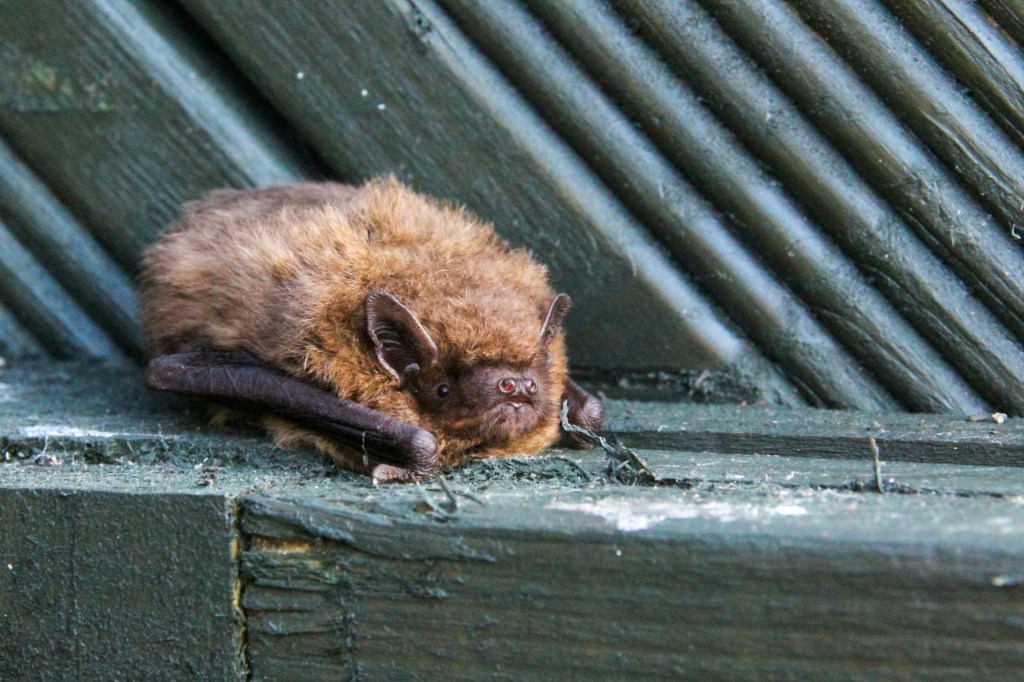
A soprano pipistrelle bat
Pillboxes
Daubenton’s bats – along with Natterers, and brown long-eared bats – are among the three bat species that have been recorded using Sudbury’s pillboxes as hibernating roosts during the winter months.

The pillboxes along this stretch of river were part of a long ‘stop line’ erected in 1940 to delay any German invasion force advancing on London. But in modern times they have been put to another use and ten pill boxes along the River Stour between Sudbury and Bures were converted to bat hibernacula in 2007 by the Dedham Vale (AONB) & Stour Valley Project, in co-operation with private landowners and the Sudbury Common Lands Charity.
According to Lavenham-based ecologist Odette Robson, who is licensed to check the roosts, conversion of the pillboxes involved fixing locked metal doors to the entrances to restrict human access because hibernating bats are extremely vulnerable to disturbance of any kind. To reduce drafts and ensure a stable internal temperature, the ventilation and gun-holes were also blocked. Bats also need a high level of humidity in hibernation roosts, so the pillboxes have a water bath to help maintain this while specially designed ‘bat-bricks’ and other roost features have been added to provide suitable crevices for bats to roost in.
The pill boxes are only used for winter hibernation when there are no insects available for bats to feed on. Bats roost in much warmer locations, such as house roofs, for breeding in the summer.
The pill boxes are checked each winter by licensed members of the Suffolk Bat Group. They are also part of the National Bat Monitoring Programme (NDMP), which uses long-term monitoring surveys to produce population trends for British bat species.
All the pill boxes have been used with overall numbers increasing in recent years, though numbers fluctuate year-to-year due to factors, such as weather and insect availability.
Good news from a hidden and secret part of the common land’s natural world.
 Suffolkwilds