
Over the drab winter months, nature starves us of vivid colours as it turns in on itself and builds up its energy for the brighter months to come. However, there are a few creatures who do their best to liven up our day.
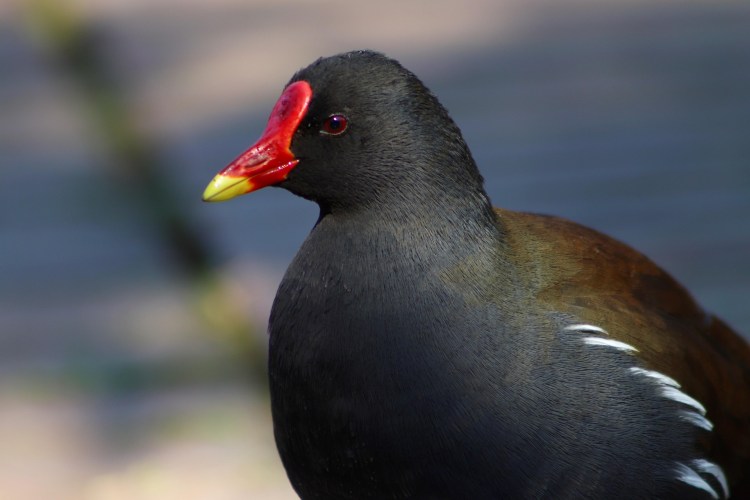
Some flashes of colour are provided by the moorhens that inhabit the waterways on the common lands. Their striking red bills with yellow tips, and yellowish-green legs offer bursts of warming hues against a background of browns and dull greens.
Now that the reeds have died back, its easier to see just how many of these attractive birds there are on the riverside. Maybe, I have noticed more because I’ve been studying their behaviour, but it strikes me this is a particularly good year for the humble moorhen.
Also, with spring arriving, the moorhens are more visible because they seem more active. I have witnessed several spats on the water, maybe females fending off the advances of males, or males facing up to competing males.
Very few things happen by accident in nature – every adaption has a use; evolutionary amendments have come about for a reason. Scientists say the dazzling colours of the moorhen’s beak are indicators for other moorhens to tell how healthy an individual is. Studies have shown that the red part of the bill is related to low levels of bacterial infection, while the yellow section is a mark of blood health, such as resistance to infection.
The brighter the colours, the more attractive the bird is deemed and the more imposing it is to rivals.
Flick
Watch moorhens for any length of time and you will not be able to ignore one element of their comportment.
Standing on the bankside, it is clear to any observer that that moorhens are immediately aware of any human presence, and they do not hesitate in swimming towards the far bank to seek shelter in overhanging foliage or among the reeds. And as they put distance between themselves and us, they constantly flick their tail up and down to reveal striking white tail feathers.
Once you see it, you cannot un-notice it but again, there is method in this behaviour. The flicking acts as a signal to potential predators that the bird is fit, aware, vigilant, and ready to flee from any attack. The closer the moorhen is to danger, or the more exposed it feels, the more rapidly it flicks. It is the opposite of camouflage – the moorhen is saying: “I can see you and you haven’t got a chance of catching me, so don’t try it.”
I have even watched moorhens rush for cover in long grass on the opposite bank of the river, and the only thing you can see is the white tail feathers flickering through the grass stems.
Considering that people must walk pass them on multiple occasions every day, our moorhens do seem skittish. Startle one on your side of the river and they will let out a shrieky ‘krrrrk’ sound before powering through the water to put distance between you and them. They might even take flight for a moment to gain a gap – but they are poor flyers, their long legs dangling beneath them, so they resemble a small hang glider.
I do not recall seeing a moorhen flying overhead, like say cormorants or mallards. They are a creature of the reeds and the waterside – not as their name would suggest ‘moors.’ An olde English word for moorhen is mere hen, where mere is the origin of the word ‘marsh’, thus another name for moorhen is swamp hen.

Nest
It is little wonder moorhens are wary of us humans. I read that in postwar Suffolk, schoolchildren would wade to moorhens’ nests and steal the eggs for the pot. Apparently, moorhen eggs are good for a fry up while pheasant and partridge eggs are better used for baking cakes.
Moorhens’ nests are scrappy affairs made from bits of reed, and the species are known for laying their eggs in the nests of others, so they can spread the chances of their young surviving. The chicks bring a smile: small, scruffy balls of black down like mini-Dennis the Menaces, with their red and yellow bills already in evidence.
We look forward to their arrival soon.
 Suffolkwilds