
After the long winter, how lovely to have a run of sunny days and blue skies.
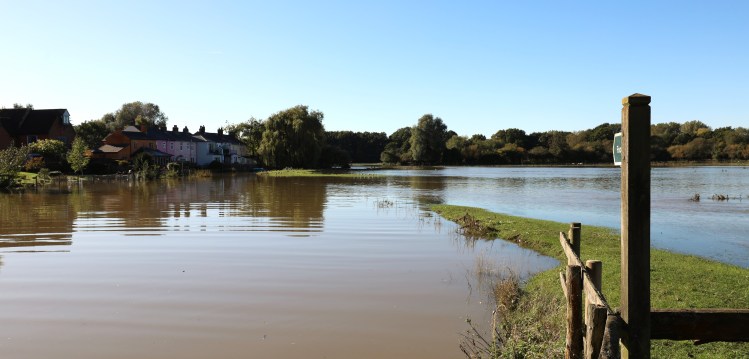
I find it strange that a term for feeling down is a ‘case of the blues’, when, for me, the overhead azure of recent weeks has lightened the spirits and made a stroll on the common lands all that more pleasant.
Is there a more beautiful colour in nature than blue? Part of what makes the cerulean hue so special in the wild world is its scarcity. Very few birds, insects and flowers boast any shade of blue – and once you dive into the world of aquamarine, you begin to realise that instances of naturally occurring blue are even less common than you think.
Scattering
Take the sky, for instance. On sunny days it only appears blue due of an effect known as Rayleigh scattering, named after 19th century physicist Lord Rayleigh, who was the first to put a mathematical formula to the phenomenon.
Sunlight is composed of a spectrum of colours but the sky appears blue because the shorter wavelengths of sunlight – like blue and violet – are scattered more effectively by tiny air molecules in the atmosphere than longer wavelengths, such as red and orange.
However, during sunrise and sunset, the sun’s light has to travel through a greater portion of the atmosphere, causing the shorter wavelengths of blue to be scattered away, leaving more of the longer wavelengths of red and orange to dominate the sky.
Likewise, the sea appears blue because water molecules absorb colours with longer wavelengths, leaving behind the shorter wavelength colours to be scattered and reflected back to our eyes.
Feathers
Even in the bird kingdom, the blues we see are somewhat of an illusion. Arguably, the most stunning blue you might be lucky enough to see on the Sudbury riverside is the streak of cyan running down the centre of a kingfisher’s back. But these feathers contain no actual blue pigment. The vibrant and iridescent tint is what scientists call a structural colour, which is created by the light interacting with the structure of the feather.
The same goes for the darker, cobalt-coloured feathers of the swallow – the microscopic ridges and valleys on the feathers’ surface, and the arrangement of cells, cause light to diffract and reflect in a way that produces an ever-changing mix of iridescent blues with hints of green.

Migration
I saw my first barn swallow of the year on the common lands just the other day, using its long tail streamers to twist and turn overhead before disappearing into the sunlight. Aristotle may have felt that ‘one swallow does not a summer make’ but it certainly felt like spring had arrived.
Underfoot, a carpet of bright yellow lesser celandine flowers, spread like miniature stars on the bank of a ditch. Nearby, carder bees worried around clusters of purple dead-nettle flowers.
It’s incredible to think that this small delicate bird had more than likely just journeyed 6,000 miles from South Africa – the place where our swallows spend the winter months. Migration of this magnitude was certainly an idea that people down the ages have struggled to get their head around.
In medieval times, people thought that swallows spent the winter hibernating, buried in the mud near ponds and riverbanks. Apparently, this belief came about because before they flew south swallows would gather among the water reeds. When people saw they had disappeared the next day, they assumed the birds had entombed themselves in the sludge to sleep out the period cold temperatures and no insects.
Ring
But it wasn’t until 1911 that we had irrefutable evidence of the swallow’s incredible journey. Just before Christmas, a South African farmer rescued a bird that was caught in his barn and discovered a metal ring around its leg. The ring – numbered B830 – had been placed on a chick’s leg seven months before in Cheadle, Staffordshire – the mystery of where these birds actually over-wintered started to become clearer.
It was a ground-breaking discovery in the field of animal migration – the inner mysteries of which scientists are still trying to unravel today.
It’s a wonder to bear in mind as we start to see more swallows moving in and through our small patch of heaven – before these beautiful birds take themselves and their beautiful blue feathers on the return 6,000-mile journey back to South Africa in the autumn!!!
 Suffolkwilds