
A day off work and a lovely warm sunny day in May.
We were walking on the banks of the River Stour on the Wardman meadows, a series of secluded pastures on the opposite side to the town where wildlife abounds, and people rarely go.
This is where the water meadows’ status as a nature reserve is revealed. Within minutes of setting off we looked skywards to see three hobbies – small, agile falcons that in-flight resemble large swifts – hunting dragonflies and damselflies. Two hares ran along the end of the meadow and disappeared into a hedge; a heron, disturbed from its place among the reeds, lazily shook its large wings and headed away from our group.
We made our way up the slope towards an area covered in clusters of cowslips, in search of the spotted leaves that signal the first presence of marsh orchids. But my downward gaze was soon drawn upwards towards the swarms of flies around us. They were mayflies, hundreds of them, all bobbing up and down like miniature, translucent puppets on a string.
One day
They were unbothered by our presence, wholly focussed on jumping as high as they could, intent on making an impression and finding a mate. This was their one day in the sun and love was literally in the air. Mayflies famously only live for a day, give or take, depending on the species, during which time they must pair up and copulate. But this mass courtship ritual that we’d stumbled upon is the endgame in a life that starts up to two years earlier.
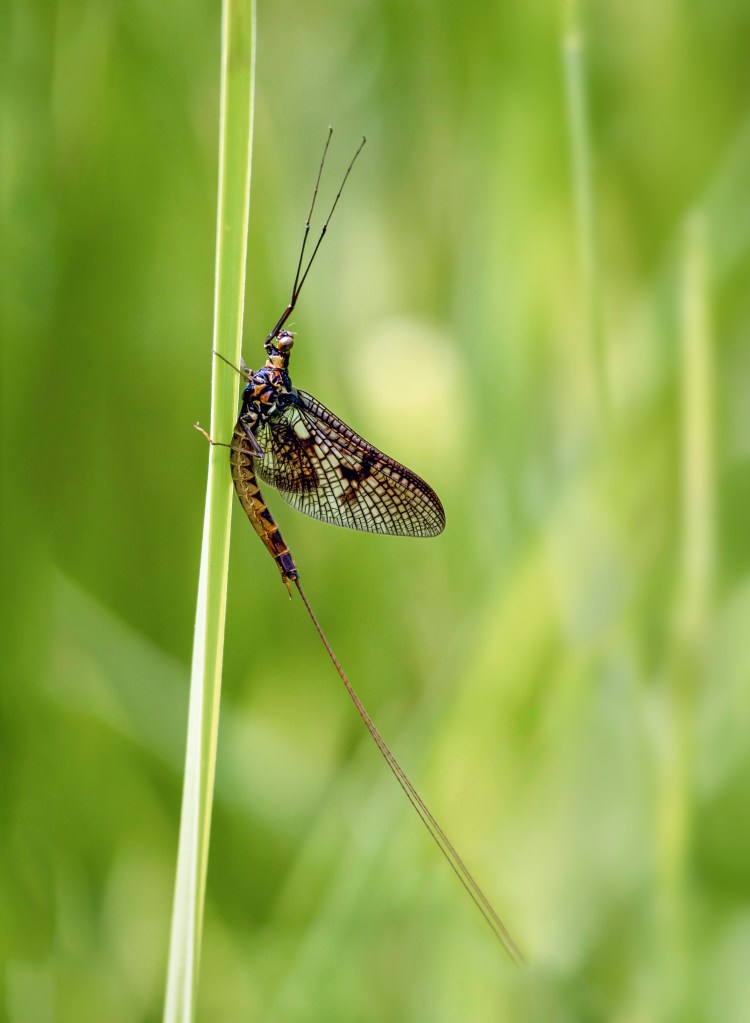
Mayfly nymphs can spend several years underwater, feeding off algae and plant debris on the river’s bottom, helping to keep rivers clean and healthy. Then, as if by magic, they will emerge as a swarm, initially in a sub-adult fly form known as a dun. These typically find some bankside vegetation where they can rest and dry in the sun. This outer skin is soon shed, as they transform into a brighter adult fly known as a spinner. Mayflies are unusual among insects in having two fly phases.
From this point, the mayfly, whose scientific family name Ephemeroptera, means ‘briefly winged,’ has an afternoon in which to make its mark on posterity. The males use all the energy they can muster on this vertical bobbing in order to attract a female. It is literally a dance of life and death, as this is their final act before they die. Incredibly, these wonderful creatures are born with only the vestiges of a mouth from their nymph stage, meaning they cannot feed and nourish themselves. All the energy stored during the nymph stage will be expended in these few hours of leaping and loving.
Fish
I watched fascinated as the flies bobbed up and down, like tiny carousel horses with long flowing tail filaments, designed to stabilise them as they bounce and act as an extra accoutrement for attracting the ladies.
At some point they will conjoin with a female and fertilise her eggs before she heads back to the river to lay them, all the time trying to avoid predation by fish. If she is successful, the eggs will sink to the bottom and ultimately hatch the next generation of nymphs, destined to repeat the cycle once more.
A mayfly emergence is not just a cause for celebration among the mayfly community, it also triggers a feeding frenzy for multiple species, from frogs to birds, but especially for fish who will look to pluck the mayflies from the water’s surface, both as they emerge as duns, and later as the females lay on the water meniscus.
It is this action that fishermen look to copy, creating colourful lures with long tail feathers that they cast into the water, trying to emulate the mayflies’ appearance and behaviour on the water, and encourage fish, such as trout to take the bait.
But unlike fishermen, who must remain patient if they are to catch their quarry, mayflies have no time to stand and stare. For them, life is a glorious instant of prancing and passion.
 Suffolkwilds