Stand at the Mill hotel, look out over the Common Lands and, save for the Millennium Pollards and the odd man-made structure, you are surveying a scene pretty much unchanged for centuries.
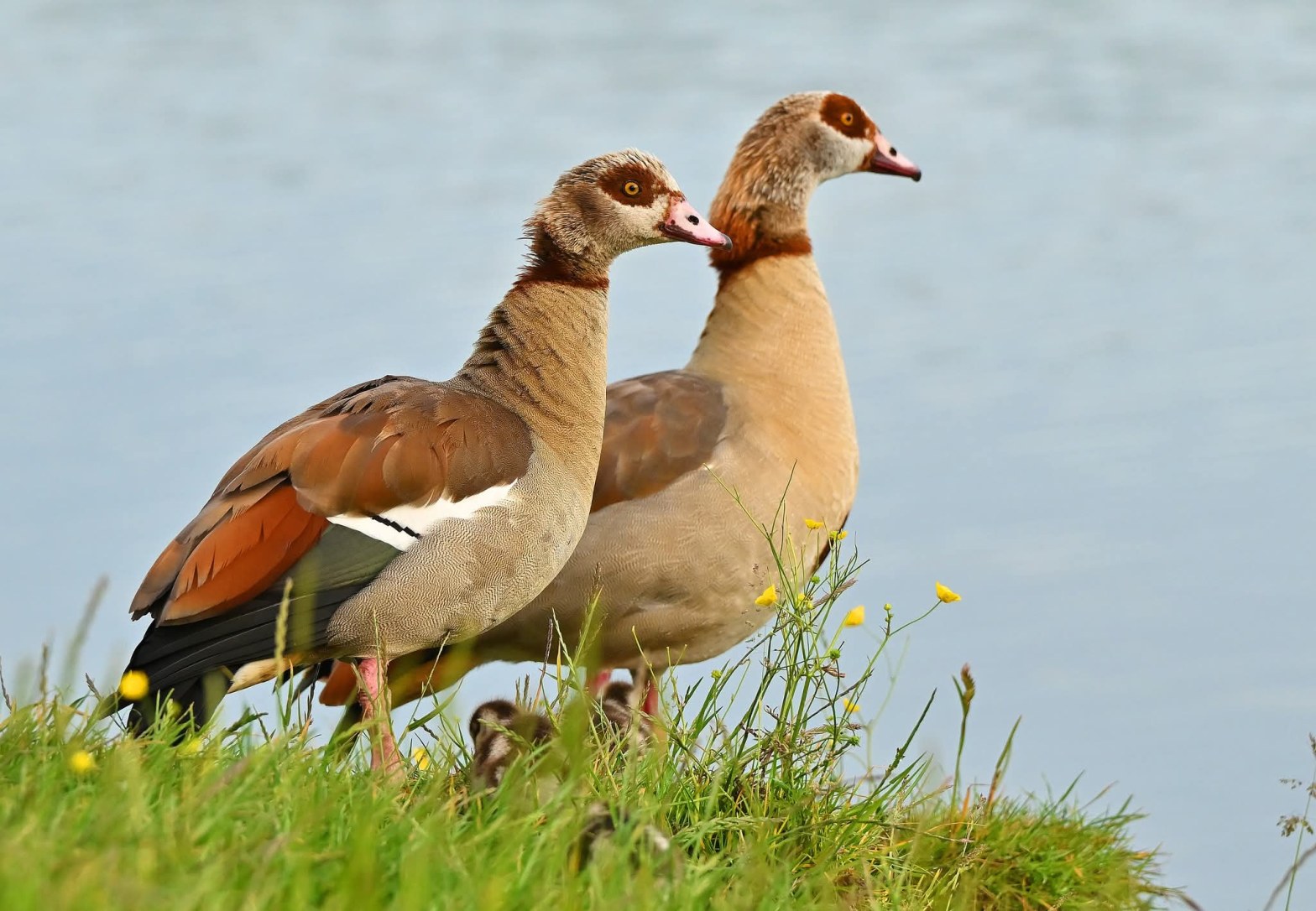
Visit the meadows regularly and you will, however, notice the odd new addition to the local flora and fauna. One such recent arrival is a pair of Egyptian geese, stocky, exotic birds that have been present here for a few summers.
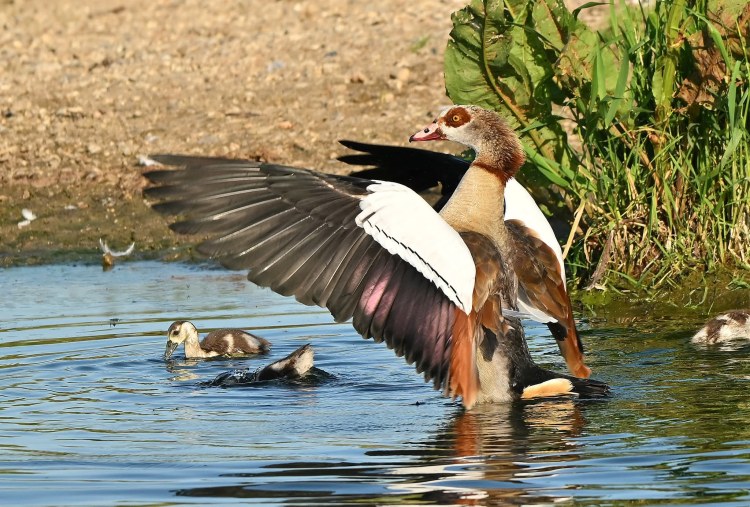
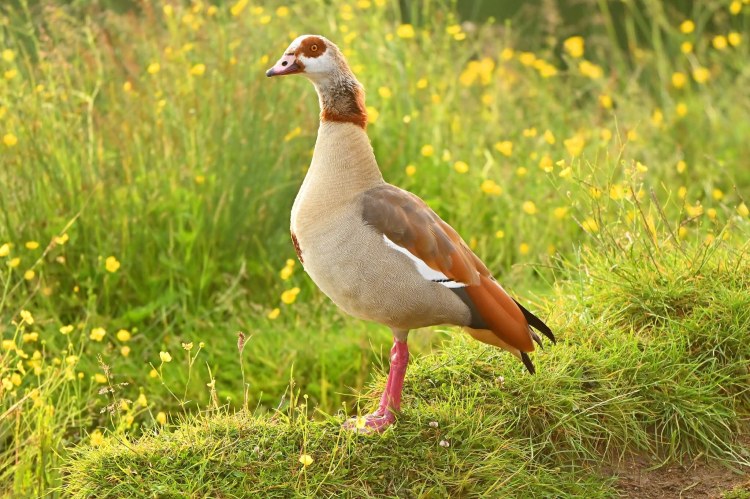
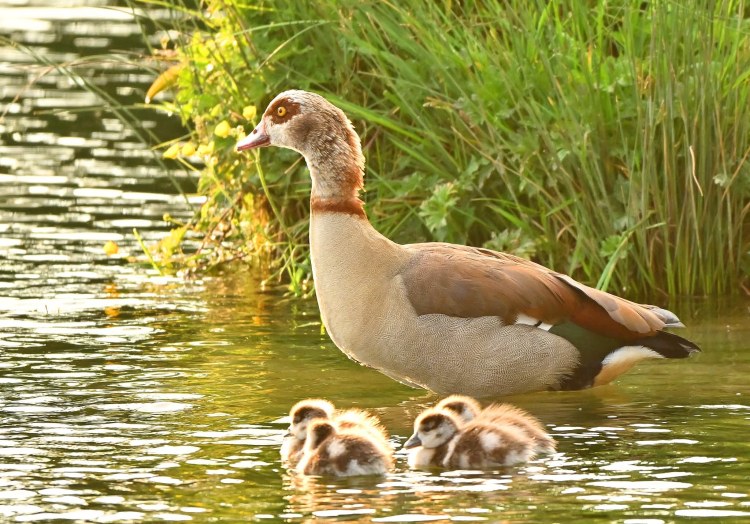
This year they seem bolder than ever and can be seen regularly around the floodgates pool with their fluffy young. As Ron Smith’s excellent photos attest, they are an extraordinary patchwork of colours: a pale, creamy brown body with a dark brown smudge on the lower breast; a silvery-brown neck and head with a darker patch around their piercing yellow eye; dark brown wings with large white panels on the inner forewing together with green and russet tail feathers; and, to top it all, pink legs and beak.
Ornamental
As this outlandish colouration and their name would suggest, Egyptian geese are not native to the UK – the breed originates from the Nile Valley and sub-Saharan Africa.
Like it was with many of today’s invasive animals, collectors brought them to these shores and initially kept them on the estates of stately homes, such as Holkham Hall in Norfolk and St. James’s Park in London. But in recent times, the birds have escaped, bred and expanded across East Anglia, so it is no surprise some have made it to Sudbury. There are also significant flocks in some London parks.
In this way, Egyptian geese are the UK’s 21st century equivalent of Canada geese – well-known and widespread black and white geese who were also introduced and spread across the country after WWII.
Their popularity as ornamental birds saw the Egyptian goose also introduced to other regions including mainland Europe and the United States where they have spread too, and, I am told, those who watch a lot of sport on television can see them wandering around golf courses during tournaments.
Ducks
To add to their mystique, Egyptian geese are not really geese. They are, in fact, related to shelducks, our largest duck species. Apparently, they were mistaken for geese because they look heavy in flight like geese. They certainly have the territorial instinct of geese. I watched the wary pair stand guard – heads held high and breasts puffed up – creating an imposing protective barrier for their young as dogs played in the shallow water across the way at the floodgates. While they made no noise on this occasion, I have heard the call of the Egyptian goose, and it is suitably loud and intimidating.
According to the Wildlife Trusts, Egyptian geese usually nest in cavities in old trees, but will also nest under bushes on islands, or in the nests of crows or raptors. They have even been recorded taking over the nests of ospreys and outcompeting barn owls to use nest boxes. It will be interesting to see if it is thought they represent a threat to native species if their numbers continue to increase.
Savannah Hypothesis
Seeing Egyptian geese establish themselves on the common lands brought to mind the evolutionary theory called the Savannah Hypothesis, which speculates that humans possess an inbuilt preference for savannah-like settings.
So the theory goes, because the majority of pre-human and human evolution took place in the East African savannah, and because modern humans descend from this population, we have a leaning towards landscapes of open grasslands and scattered trees and copses. In fact, a landscape very much like the water meadows. Maybe, that is why we find the common lands so endearing?
Now Egyptian geese, who originate from Africa and will undoubtedly be found on savannahs over there, have made a home on terrain similar to their own thousands of miles away. But instead of milling around zebras and hippos, our pair find themselves among cattle, swans and dog walkers.
All photos: Ron Smith
 Suffolkwilds