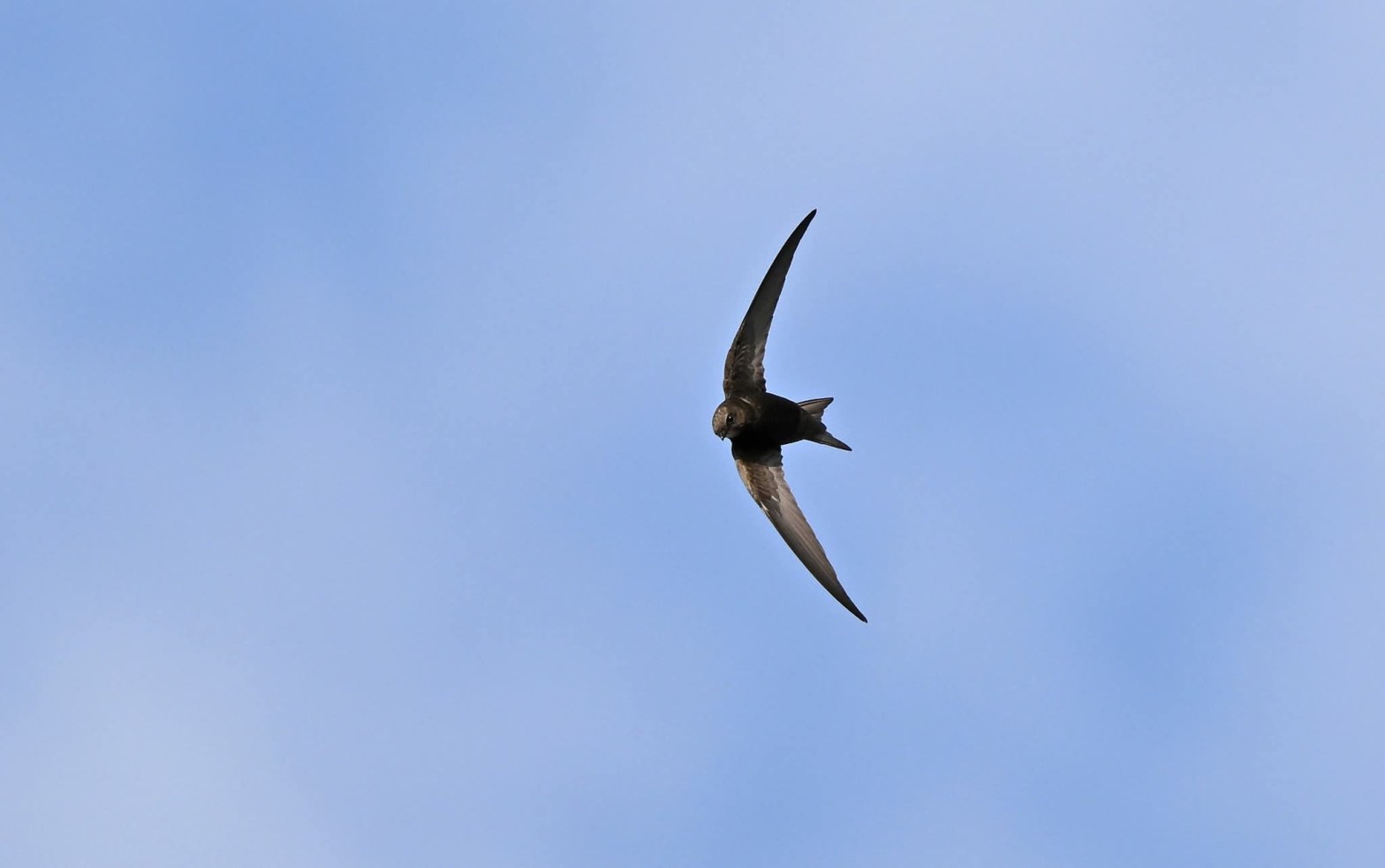
Thank you to Ron Smith for these pics of a swift over Sudbury
August is a quiet month, and not just because the schools are closed and people are away on their holidays.
Wildlife-wise, there is little birdsong because the breeding season has come to an end, making singing unnecessary for establishing territory or attracting mates.
One sound I miss more than most is the high-pitched scream of swifts – a soundtrack to early summer in Sudbury that has now ceased, as the birds have already left on their long journey to West Africa and beyond into the interior of the continent where they will spend the winter.
I saw a cluster of about 15 swifts above Sudbury heading in a southerly direction about three weeks ago and I wonder if this was our local collective having got together to start their migration.
Typically, I see swifts in smaller groups – their numbers sadly declining by the years. A band of four or so can sometimes be seen circling around St Peter’s church where swift boxes have been installed in the tower. Recently, I watched seven swifts circle and race overhead as I backstroked up and down the outdoor pool at Cornard Leisure Centre.
The gang who take up summer residence near my house on Weavers Lane each year numbered four or five this time round. One pair must have a nest site in the eaves of the old Vanners factory as they often swooped and shrilled over and around the adjacent car park and took turns shooting into a gap under a gutter. When the factory site is redeveloped, I will let the authorities know, so alternative nesting sites can be factored into any plans
The sheer vitality of swifts – the speed and sound – is a wonder of the animal kingdom that leaves many of us in awe of these small creatures.
Poet Ted Hughes described them thus: A bolas of three or four wire screams/ Jockeying across each other/ On their switchback wheel of death./ They swat past, hard-fletched/ Veer on the hard air, toss up over the roof,/ And are gone again.
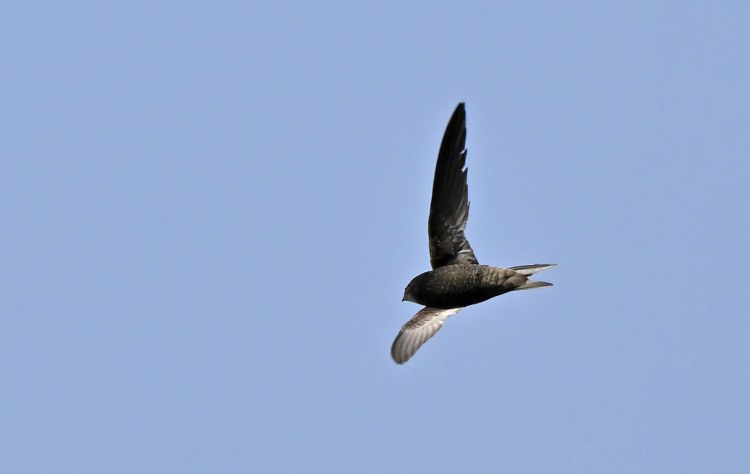
Aerial existence
The scientific name for the common swift is Apus apus – where apus comes from the Greek word meaning ‘footless’ or ‘without feet.’ This references their small legs and feet, which are adapted for clinging to walls and rock faces rather than perching. If you see a swift on the ground it is likely to be a young one that has left the nest too early or an adult that is injured or exhausted. Otherwise, swifts spend almost their entire lives on the wing, only landing to nest high up. They are remarkably adapted to this aerial existence and feed, mate and even sleep on the wing.
A memorable wildlife encounter for me was canoeing on the Stour and seeing swifts dive-bombing the water around me as they took a small drink with each swoop. In researching for this article, I also found a video clip purporting to show swifts mating in mid-air – it was the definition of a quickie!
One incredible adaption for the swift’s aerial lifestyle is that they literally sleep with one eye open, making use of unihemispheric slow-wave sleep. This means one hemisphere of their brain enters a deep sleep state while the corresponding eye closes, and the other hemisphere stays awake and alert with its eye open. This allows them to rest without crashing, maintaining navigation and avoiding predators. Other animals to use USWS include dolphins, whales and seals.
During the night, swifts can rise to higher altitudes and allow themselves to be swept along in this state by air currents, reducing the risk of collision with structures. I’ve read reports of World War One fighter pilots on special missions climbing high and finding themselves among swifts travelling zen-like in this way.
This travelling technique certainly enables them to cover much airspace in a short time. One individual, fitted with a transmitter, was recorded as taking only five days to travel 5,000 km.
So bon voyage to Sudbury’s swifts, we look forward to your safe return in May next year.
 Suffolkwilds