
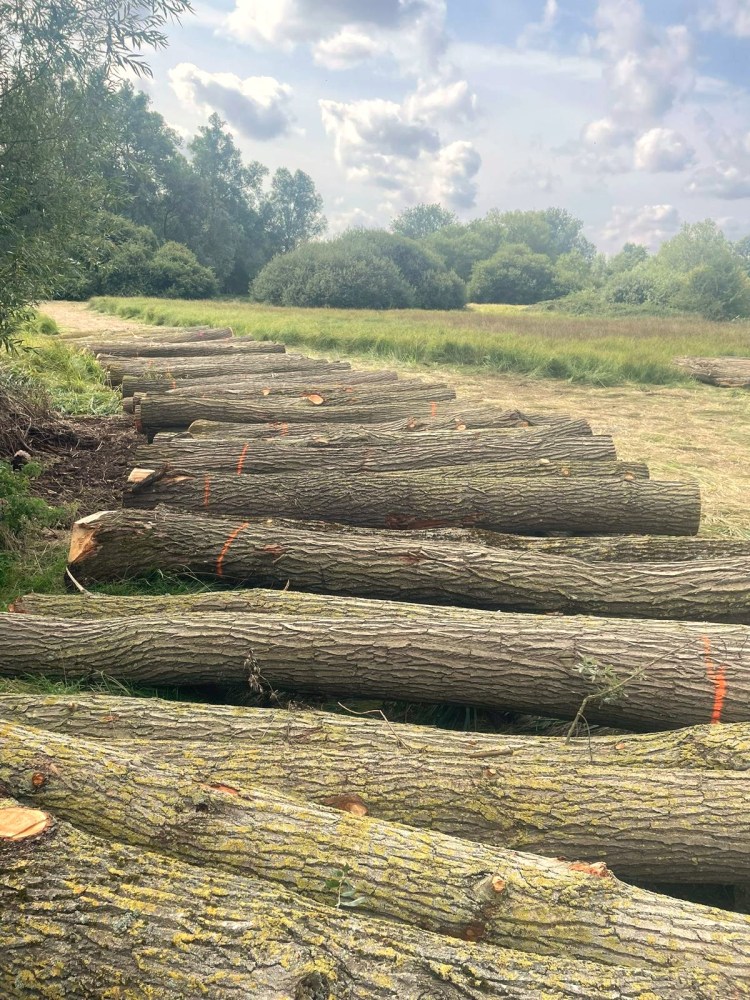
Last month 26 cricket bat willows were felled on land close to Cornard riverside. This is a cash crop, specifically planted to be harvested; a link to time-honoured practices and a revenue-generator for the charity.
East Anglia has traditionally been the commercial heartland for cultivating English cricket bat willow, whose scientific name is Salix alba caerulea.
The region’s low-lying areas and high-water table, especially near rivers and floodplains, provides the damp, moisture-retaining soil crucial for the tree’s health and fast growth. Willows planted in these areas can easily access the groundwater they need to flourish, while the temperate English climate, usually characterised by cool winters and wet summers, is considered the ‘goldilocks zone’ for producing premium cricket bat willow – lightweight wood with long fibres that make it strong and resilient.

Prized
These cricket bat willows are managed and harvested by a company called Edgar Watts Ltd., based at Bungay in north Suffolk. They have been in the trade for a hundred years and own Lady’s Island in the Stour at Sudbury where they also grow their own cricket bat willows.
Managing director Peter Watts tells me it takes around 15 years’ growth before a cricket bat willow is ready to be harvested. A rough guide is that a tree is suitable when its circumference reaches 56 inches at chest height. Before this point is reached, green shoots on the trunks are pruned two or three times a year to prevent them hardening into woody branches. This ensures the trunk grows straight and free of knots, producing the clean, white wood prized by cricket batsmen the world over.
What Peter and his team are hoping to get when felling cricket bat willows is a ten-foot-long straight trunk, cleared of all upper branches and foliage. Each one of these trunks will produce 40 clefts, the rough sections of wood, which are sent to bat makers for shaping and finishing.
Cricket bat making
These days, most of this wood is destined for northern India – the epicentre of the world’s cricket bat making industry where the major manufacturers have a presence. Some of the clefts will remain in England; years ago, I followed the progress of some cricket bat willow harvested on Cornard’s riverside to a small cricket bat-making business based in West Row, north of Bury St Edmunds, and saw how bats are made.
The initial cleft is dried both naturally and by kiln before being machined to carve out the basic bat shape. Then a series of hand tools are brought to bear – block planes, spoke shaves, draw knives – which are used to customise the bat and give it the appropriate balance.
I learnt the grain structure of the wood is key – a piece of wood that has a straight grain, evenly spaced with few blemishes is the most sought after. Cricket connoisseurs will also tell you that it is preferable to have mostly flexible soft wood in your bat rather than the harder heartwood that tends to be more brittle – and increases the chances of the bat breaking.
Planting
The team will restart the cycle again this winter when they intend to plant new willow ‘whips’ in the same area. These whips are typically 15 feet in length and pushed a few feet into the soil. They generally plant many more whips than are cut down because some will not take and others will be nibbled away by deer, despite the use of plastic deer guards.
A proportion of cricket bat willows is also taken by watermark disease, which causes a reddish-brown discoloration of the internal wood (the watermark) that weakens the wood, making it unusable for cricket bats. The disease also causes branches to wilt and die back, and trees exhibiting these symptoms are removed to stop the infectious disease spreading throughout the crop.
There is still another weekend of cricket in Sudbury to come while the Ashes series in Australia starts in November. Maybe next time you hear the sound of ‘leather on willow’ you will think on the long process of producing cricket bats and the connection with our fertile riverside.
Pics: Alex Faiers
 Suffolkwilds