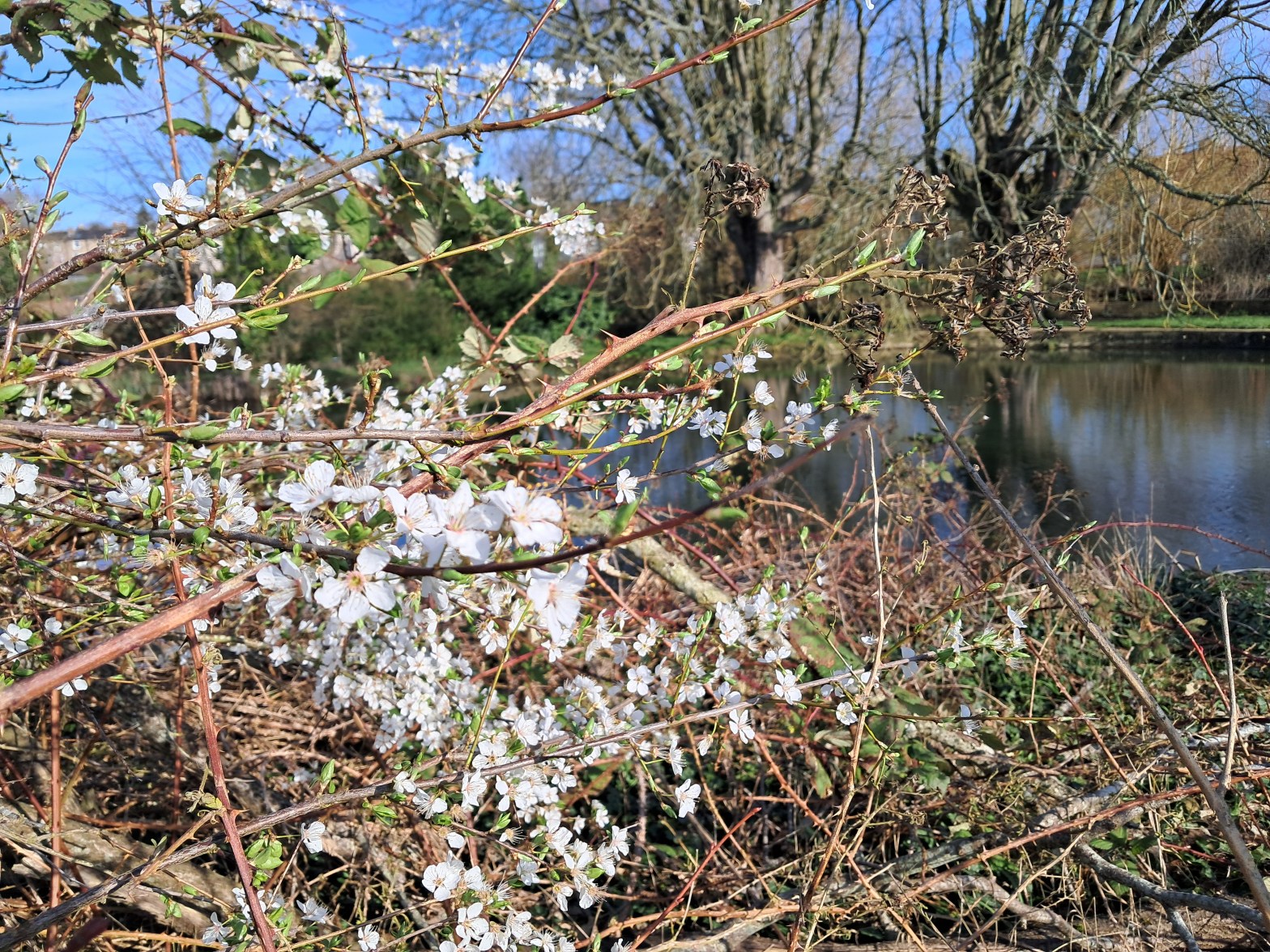
As February moves to March, our hedgerows come to life with the first blossoms of the year. The frothy white flowers of the blackthorn appear even before its leaves do, looking like clusters of cotton wool in the otherwise dark and foliage-barren low treeline.
Often, they bring with them a false hope that spring has arrived. It is frequently the case that winter has at least one last chilly blast to offer us before we can start thinking of putting our woollies away. This sudden return of cold weather in early spring when the blooms are already out is what is known as a blackthorn winter.
Unlike the sickly pungency of the hawthorn blossom, which shows two months later, the scent of the blackthorn is soft and lush although it can be difficult to describe exactly. I say it smells like honey, my wife thinks almonds. A young girl who was sniffing the blossom with her family in a Lavenham park last weekend told us she was getting ‘pineapple’.
Blackthorn is however related to fruit trees such as plum, cherry, peach and apricot. All these are members of the Prunus genus. After pollination, the blackthorn’s flowers develop into sloe berries – blue-black fruits that every schoolkid knows are too astringent to eat raw but, most adults are aware, are the main ingredient for sloe gin, a moreish, sweet and gloopy liqueur that warms the cockles at Christmas.

Hedgerow
The full scientific name for blackthorn is Prunus spinosa, the spinosa bit refers to the tree’s large and vicious thorns that grow straight out from its twigs. They are hard and sharp and have caused a few punctures on my mountain bike over the years, forcing me into an impromptu yomp home, pushing my contraption. But these thorns have their uses – making blackthorn a good hedgerow tree, shrubby and gnarly, and along with the hawthorn, used to form a dense barrier, keeping animals in a field and people out.
Other creatures also benefit from the blackthorn’s early flowers, which provide a valuable source of nectar and pollen for bees in spring. Its foliage is a food plant for the caterpillars of many moths, including the lackey and magpie, and the black and brown hairstreak butterflies. Birds nest among the dense, thorny thickets, eat caterpillars and other insects from the leaves, and feast on the sloes in autumn.

Good and evil
As you might expect with a tree so gnarled and dark (blackthorn’s bark isn’t really black, more slate-grey), there is a great deal of folklore linked to the blackthorn.
It is heavily associated with witchcraft. Back in a time when superstition held more sway, witches were believed to craft wands or so-called blasting rods from its wood to cast curses. Its sharp thorns were said to be used in sympathetic magic, such as sticking them into dolls like voodoo.
But despite its dark reputation, blackthorn thorns could also be used for good, to ward off evil spirits. It was looked on as a guardian tree and a portal to the fairy world.
Much of this folklore heralds from Ireland whose people, it would appear, have traditionally had a strong link with the blackthorn. Its toughness made it the wood of choice when making a shillelagh – a traditional Irish walking stick and club with a large, heavy knob at the top. From the reading I’ve done, back in 18th and 19th century Ireland, the shillelagh was used to settle disputes and to defend oneself – an informal form of order referred to as Shillelagh Law in the ballad Finnegan’s Wake.
Shillelagh makers would nestle their sticks in chimneys to season and harden the wood and make them blacker. There are reports that the wooden knobs were sometimes hollowed out and filled with molten lead to give more weight to their impact.
I read one bizarre anecdote about a man who was killed with a blow of a shillelagh in a fight at the Fair of Roscrea in County Tipperary. At the subsequent trial, the judge is said to have let the accused go, reputedly saying that the evidence showed the victim had an unusually thin skull and that the Fair of Roscrea was ‘no place for a man with a thin skull.’
 Suffolkwilds