If you are feeling an extra skip in your step because there is more sunlight in your life, you are not alone.
Here in Suffolk, the most significant daylight gains of the year occur during March and early April, as the Northern Hemisphere tilts towards the sun. At the moment, we are gaining up to three minutes of daylight every day; by the end of the month we will all benefit from an hour more daylight compared to the start.
In the natural world, this extra light changes everything: animals start to forage, and birds start to sing and collect twigs and dried grass – material from which they can build a nest. On my walks over the Easter weekend, I heard the song of a blackcap, saw skylarks ascend over fields and ran into brimstone, peacock and small tortoiseshell butterflies, all newly emerged from hibernation.
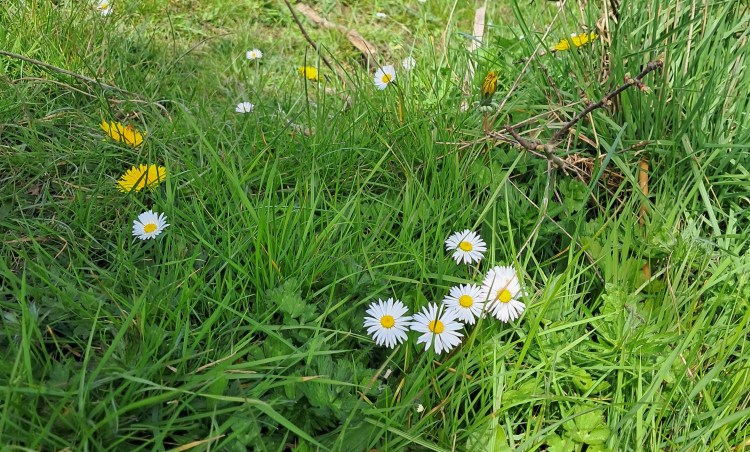
On the Common Lands, where the first cattle of the grazing season are now making themselves at home, daisies and dandelions have proliferated. On river banks, clusters of lesser celandine – low-lying, yellow star-like blooms, are also showing.
Dead nettles
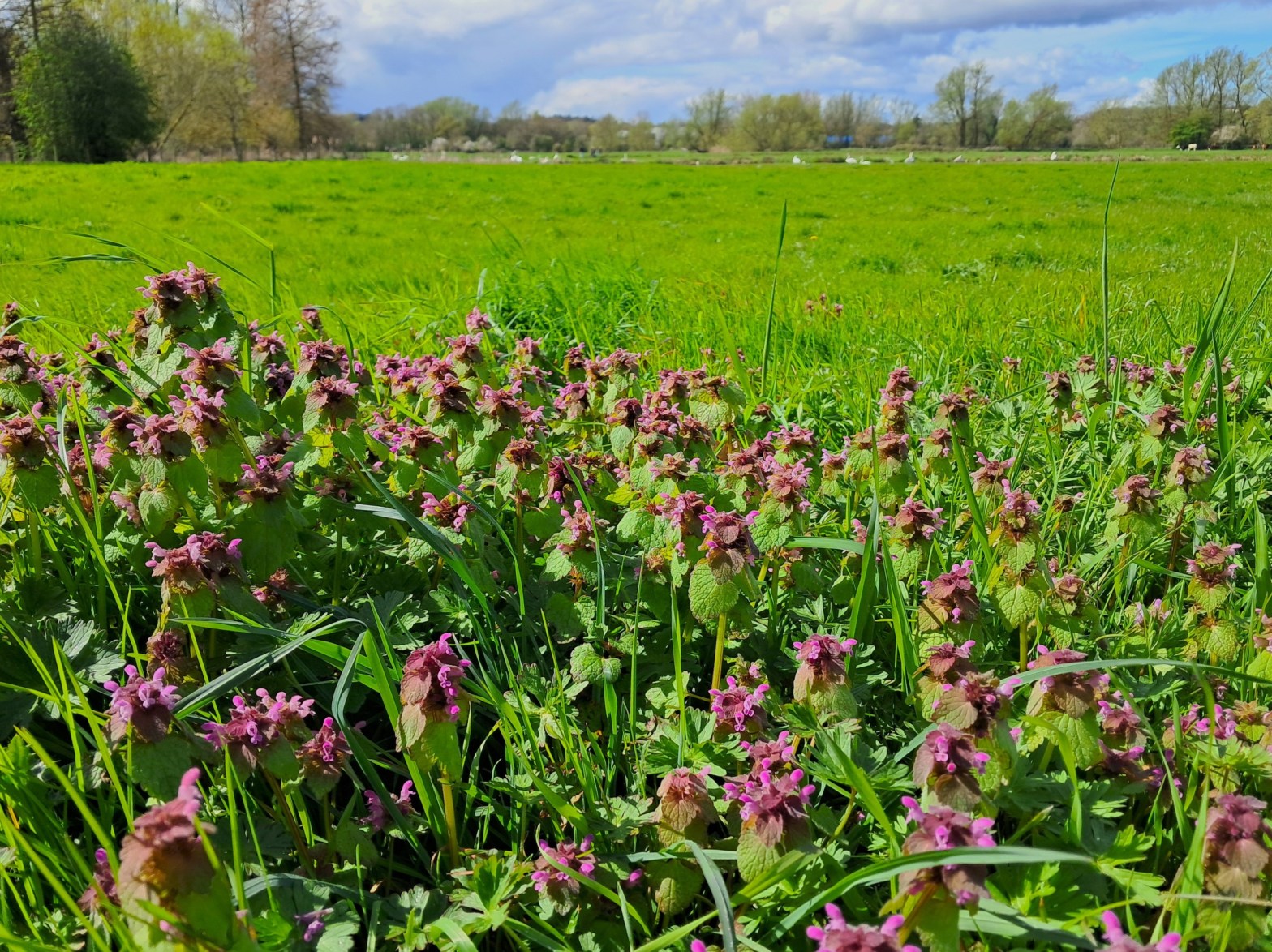
The flowers of the purple dead-nettle and white dead-nettle are also in evidence. Easily overlooked, they are worthy of closer inspection.
Although they resemble stinging nettles, these dead nettles have no stinging hairs – thus the name ‘dead’ – and their leaves are downy. In fact, both species are members of the mint and sage family and are not even related to the stinging nettle – it is thought they evolved to look like stinging nettles as a defence against predators.
Of the two, the larger white dead-nettles (Lamium album), which can grow up to 60 cm high, bear more resemblance to the stinging variety and can be used to jokingly fool naïve friends into thinking that you are impervious to pain. The low-growing red dead-nettles (Lamium purpureum) often huddle together in groups and like the white dead-nettle have beautifully intricate, hooded flowers that offer important early sources of nectar to insects.
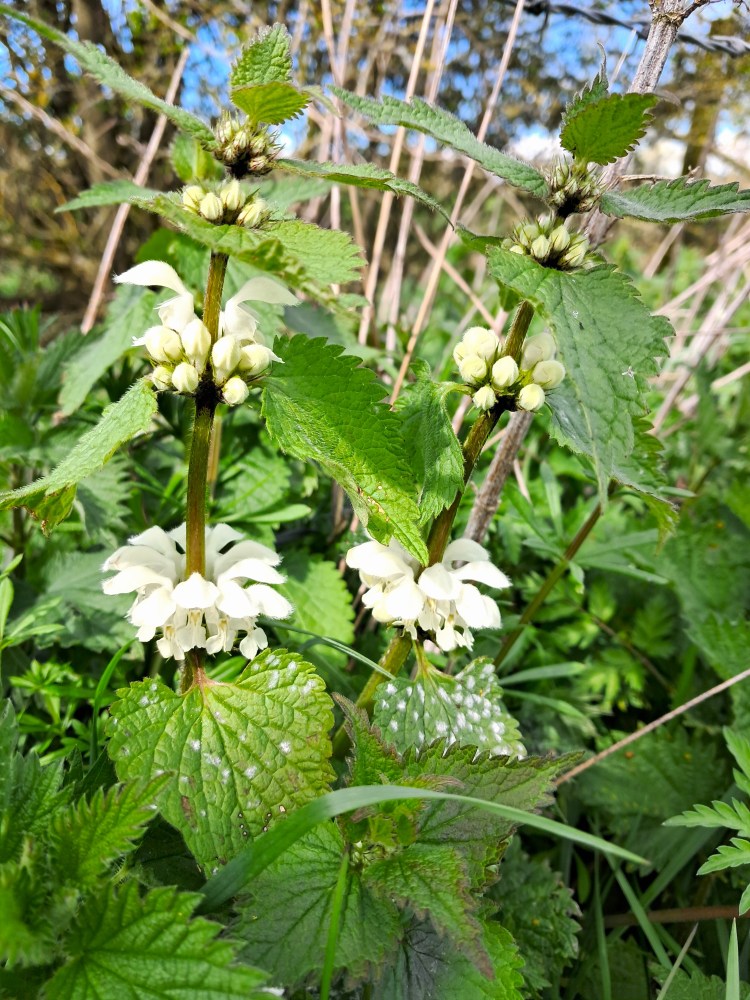
A study by the UK Pollinator Monitoring Scheme found that bumblebees are the most common insect to visit white dead-nettles. The long, narrow corolla of dead-nettle flowers is difficult for many insects to navigate, but long-tongued bumblebees are perfectly equipped to reach down and access the nectar. Because of the flower’s shape, bumblebees have to brush their backs against the stamens concealed within the flower’s hood in order to drink the nectar. These stamens are covered in pollen, which the fluffy bumblebee will pick up and deliver to the next dead-nettle flower they encounter.
Weeds
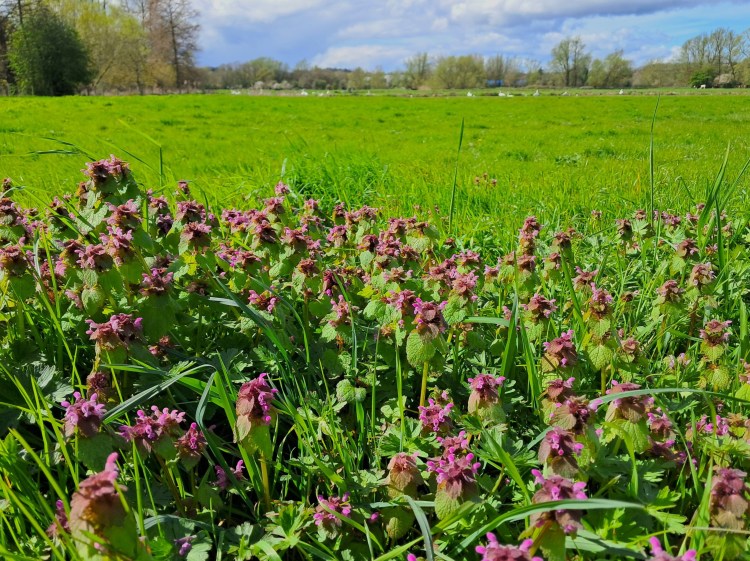
Like all nettles, the white and purple dead-nettles are known to quickly spread across disturbed ground. The purple dead-nettle, in particular, does not like competition from other plants, so thrives by being quick on the uptake when space becomes available. On the Common Lands, near the Old Bathing Place, purple dead-nettles can be seen spread along the fence line where new posts were installed and the earth disturbed.
There is also a spattering of purple dead-nettles on my lawn this year, giving me more chance to study their four-sided, square stem and heart-shaped leaves. Many people may consider them a weed but I have let my garden over to wildflowers.
And in any case, the term ‘weed’ is one I find problematic.
A general definition for weed used by the Royal Horticultural Society (RHS) is simply any plant ‘growing where it is not wanted’. Weed is not a formal botanical classification, but rather a subjective term for plants that interfere with human activities – such as gardening or farming – by competing for nutrients, space or simply by being aesthetically unappealing.
But on the Common Lands, these rules do not apply (except to some thistles) and all wildflowers are a welcome sight. And for every definition, there is a counter-description, and for weeds there are many. For 19th century philosopher Ralph Waldo Emerson, a weed was “a plant whose virtues have not yet been discovered.” I also like the definition put forward by American columnist Doug Larson who opined: “A weed is a plant that has mastered every survival skill except for learning how to grow in rows.”
Great comfort to naturalists and lazy gardeners everywhere.
 Suffolkwilds