Pics from Ron Smith
A crisp, sunny winter’s morning and a day off work – I had singled out this Friday for a long stroll along Sudbury’s riverside and the weather was with me.
It was one of those days to lose yourself in nature, and as I walked onto the common lands, I felt like I had gone through Alice’s looking glass into a fantastical world, a haven from all the artificial complications of modern life.
Everywhere there was birdlife: the humming throb from the giant wings of a mute swan flying low overhead; the flicking white tails of a pair of moorhens as they scurried through the long grass back to the brook; a prehistoric-looking cormorant winging straight and energetically across the scene.
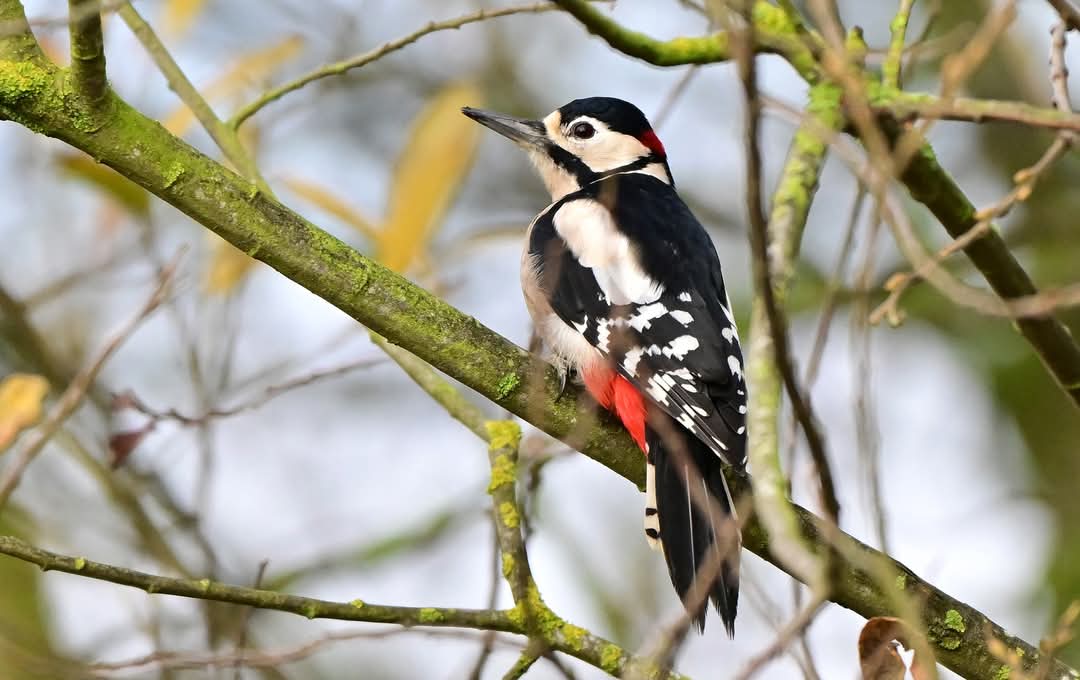
Then, a bird call I was unfamiliar with: a clipped chirp, coming from above. Perched on one of the higher vertical branches of a riverside willow was a great spotted woodpecker. Without my binoculars, I could just make out the dab of red on its underside and the magnificent black and white primary feathers.

Special occasion
Great spotted woodpeckers are not uncommon but also scarce enough to make a sighting a special occasion. Their colourful markings also lift the spirits. Up there against the dense blue of the sky, it looked wonderful.
I had never seen a woodpecker on the common lands proper but have had several sightings in the wooded area of Kone Vale near Middleton Road. One time I remember manoeuvring to get a better look at a great spotted woodpecker in its classic pose, gripping the trunk high up in a tree. Every time I moved, so the bird shuffled a few inches further around the trunk to stay out of sight. This pas a deux continued for a short while before woody took flight.
Another time, I watched a great spotted woodpecker visit a bird feeder in Long Melford Country Park. I later read that they particularly like peanuts and suet. The great spotted is the UK’s most common woodpecker and this ability to adapt and get nourishment from garden feeders is key to their success.
Drumming
The sound I associate with great spotted woodpeckers is a loud drumming, as they hammer their beaks against a hollow tree trunk. This distinctive reverberation resonates throughout a wood and is best heard in spring, as the male advertises his availability to females and his vitality to potential male competitors.
It is how woodpeckers got their name – the scientific term Dendrocopos derived from the Ancient Greek words dendron which means ‘tree’ and kopos which means ‘striking.’
But to achieve this sound the greater spotted woodpecker (and woodpeckers in general) must strike the wood surface with force and high frequency, up to 40 times a second, according to sources. Therefore, woodpeckers have evolved a number of incredible adaptations that help protect their brain from injury – modifications that have been studied by scientists to see if they can learn anything that might assist in reducing brain injuries in high impact sports like rugby and American football.

Hyoid
Key factors include a thick, spongy skull bone that cushions impact. Their brains are also anchored in the skull with a special structure that helps reduce the risk of it rattling around during high-speed pecking.
Another mind-boggling adaption is a highly specialised hyoid bone that holds the tongue in place. It is unusually long and extends from the base of the bird’s throat, wrapping around the skull. It is supported by muscles and ligaments, which allow the tongue to stick out way beyond the length of the beak to reach larvae and insects in the tree bark. In addition to this feeding function, the hyoid structure also acts as a shock absorber, deadening the impact caused by the woodpecker’s drumming.
‘Bird brain’ is typically used as a derogatory term, but when it comes to woodpeckers these sophisticated adaptions are the result of millions of years of evolution.

