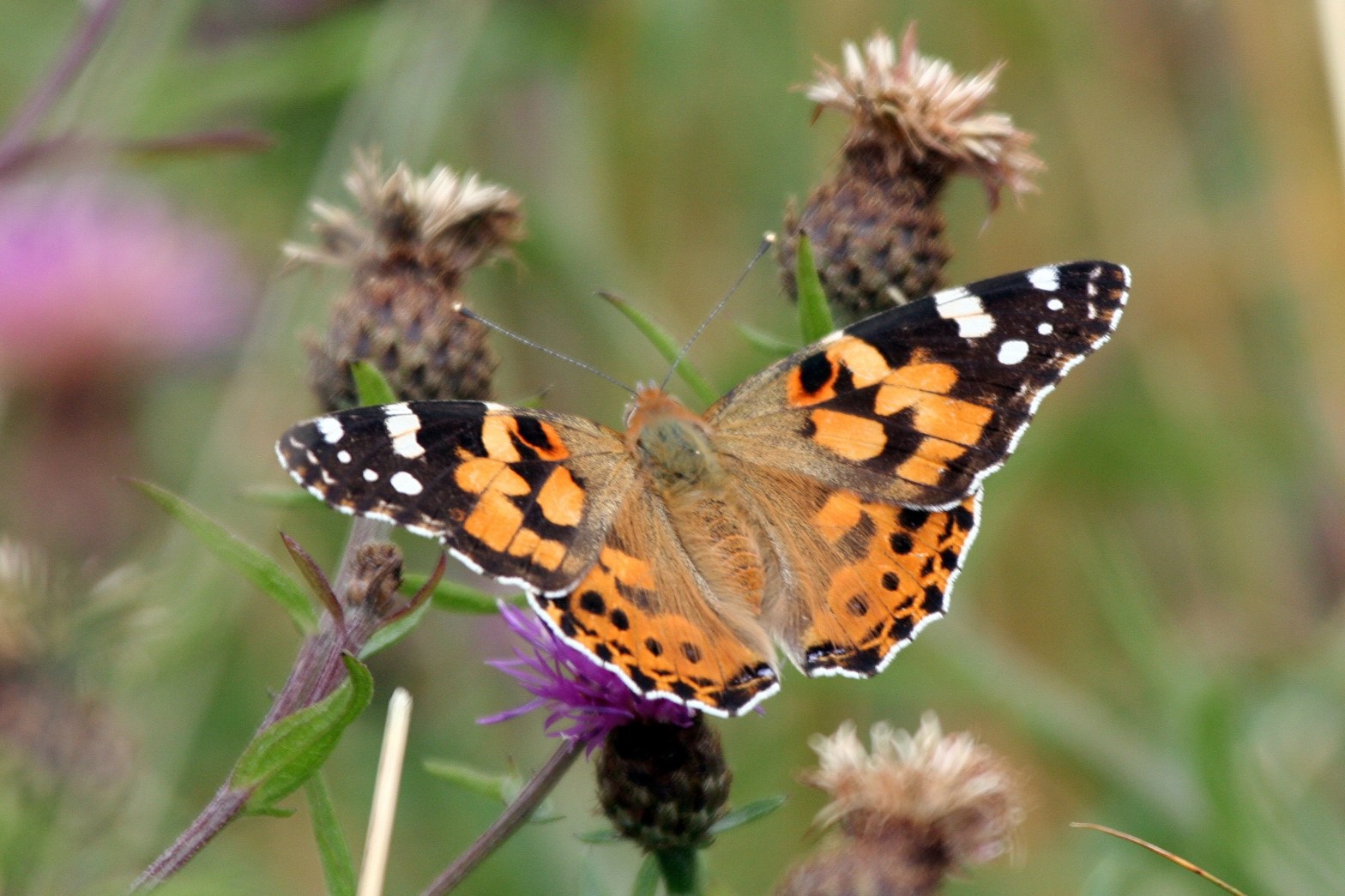
The unusual warmth of last month’s spike in temperatures brought many heat-loving butterflies out. Sightings that stick in the memory include a gorgeous yellow brimstone busying itself by a woodland margin on the Common Lands and my first red admiral of the year on a garden flower bush.
I also saw a number of painted lady butterflies in Sudbury and Ipswich, noting at the time that there were more of these stunning migrant flyers than I normally see at this time of year. I read a few days later that experts are predicting that 2026 might turn into a ‘painted lady summer,’ a once in a decade bumper year of these striking insects with black, white and pinky-orange markings on their long wings.

Migration
But for a ‘painted lady summer’ to occur, conditions must be perfect – not just in the UK but all along its incredible journey from its breeding grounds on the desert fringes of North Africa and the Middle East to northern Europe. For these delicate butterflies undertake one of the most extraordinary insect migrations known to man, covering thousands of kilometres across deserts, seas, and mountain ranges to reach our shores.
The journey is so long – up to 12,000 km one way – that no single painted lady butterfly completes the entire migration; instead, several generations contribute to the expedition, emerging from eggs laid by female painted ladies en route and taking up the next leg of the passage like a member of a relay team. Scientists estimate it can take up to 10 generations to complete the entire return journey.
As spring arrives, favourable winds help carry the butterflies across the Mediterranean Sea and into mainland Europe with successive generations of painted lady butterflies moving northward. Painted ladies can progress from egg to caterpillar to chrysalis and emerge as an adult butterfly in less than six weeks if the weather is warm, so a new generation can swiftly emerge to carry on the journey.
The migration of the painted lady is an incredible natural phenomenon, equal to the best-known butterfly migration in the world – the journey of the monarch butterfly from Mexico to Canada and back. For a long time it was thought painted ladies did not attempt a return journey until researchers realised that departing butterflies were flying undetected hundreds of metres high to catch the best winds.
There is still a lot to reveal about the mystery of the painted lady’s migration. It is widely believed they use a sun compass to navigate, while, according to the Wildlife Trusts, lab tests have revealed that the lengthening or shortening of days is the painted ladies’ cue: caterpillars growing while days are lengthening become adults who fly northwards. When days shorten, the butterflies are born with an awareness of the need to travel south, to warmer climes.

Local conditions
In a recent blog, Head of Science at Butterfly Conservation, Professor Richard Fox, explained that at each step of the painted lady’s journey, the butterfly’s breeding success will be impacted by local conditions, such as the availability of caterpillar foodplants, the weather and population levels of natural predators such as parasitic wasps and flies. If painted lady caterpillars find enough food and safely pupate, there will be more adult butterflies to take on the next leg of the onward journey. And if a high number of painted ladies make it to the UK, there will be more of a chance of a mega – emergence when the offspring of the eggs laid here emerge in August.
It’s clear a lot of variables have to coincide for large numbers of painted ladies to congregate – some years I hardly see any but experts say this year shows promise, so fingers crossed.
The last truly abundant painted lady summer was 2009 when tens of millions of painted ladies were reported across the country. In his superb book The Butterfly Isles, East Anglian nature writer Patrick Barkham describes witnessing a swarm of more than 100,000 in a field of thistles on the South Downs, the ‘dancing butterflies strung through the skies like fairy lights’.
Thistles
A key element that determines the success of painted ladies is the health of the thistle plants they find along the way. The scientific name for a painted lady is Vanessa cardui, where cardui is Latin for ‘of the thistle’ – given to the species because thistles are the primary host plant for its caterpillars and a favourite nectar source for the adults.
This is certainly good news for our rangers who must manage the thistles on the Common Lands each year. Some must be cut back so they don’t take over but some are left as they provide a valuable food source for a range of bees, moths and beetles…and of course, the painted lady. When Barkham saw the swarm in Sussex, he noted that all the thistles had been left without leaves and that they were ‘just a stem, nibbled to a thin yellow scar.’

