A key difference between summer and winter is the presence of insects.
During the colder months, flies, beetles and bees disappear, many reverting to a state of diapause where their metabolism slows, allowing them to hunker down and survive the harsh weather and lack of food.
But during the height of summer, one is spoilt for choice. Insects are ectothermic, that is ‘cold-blooded’, meaning their body temperature depends on the external environment. So, as the mercury rises, we see an upturn in insect activity. Many insect species emerge in spring and summer from a winter resting phase to begin their winged adult life stages. At this point they are highly mobile and looking to mate.
The majority of our insects are small, quick and elusive, and easy to overlook but if you don’t take notice, you are missing out on a major part of the natural world – scientists estimate that insects make up to 90% of all species of animals on the planet and more than half of all living things.
There was certainly an abundance of bustling bugs to see last Saturday as I took a walk across the sun-parched common lands. Down by the river on Great Fullingpit Meadow, there was a cool breeze; willow trees swayed, showing the silver and green sides of their leaves as they twisted in the wind. A magpie cackled from the tree line while the shouts from the football pitch echoed around the space.
Bumblebees
Purple loosestrife and willowherb brought colour to the riverbank as I spotted a buff-tailed bumblebee – our biggest bumblebee – crawling across the pink flower heads of acrimony. Nearby a fluffy, brown-and-orange common carder bumblebee, hunting for nectar, climbed into the funnel of a white bindweed flower stretched across a profusion of blue comfrey. Bumblebees never fail to raise a smile, they are furry and social, and lap up nectar using their long hairy tongues, which they fold under their head during flight.
Flies
There were certainly a lot of flies around. The cattle lazily shook their head, irritated by the face flies that were gathering around their nose and eyes. It looks uncomfortable but it is entirely normal – face flies feed on the tears of cattle but must be controlled as too many can cause a condition called pinkeye.
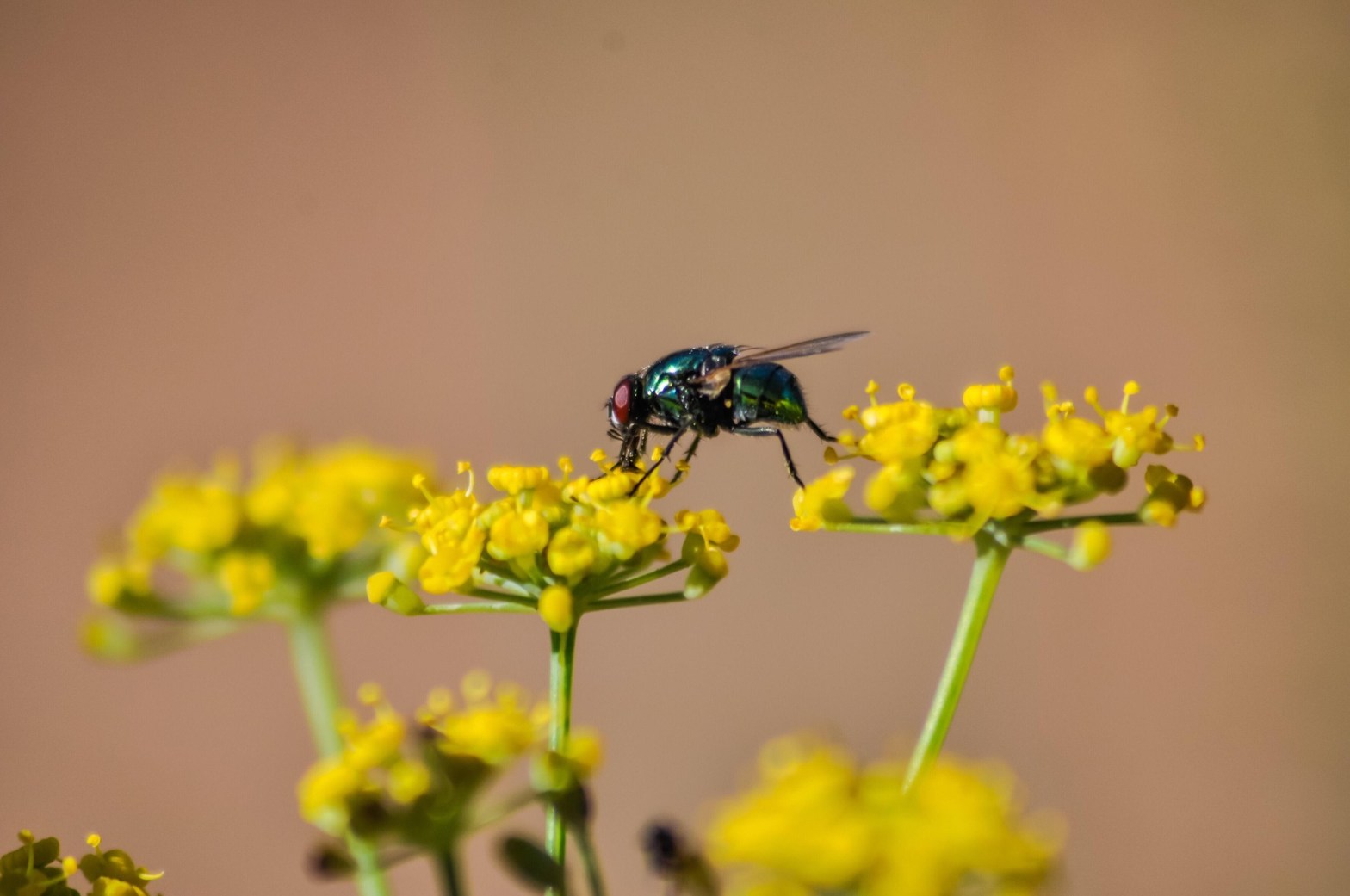
I saw an iridescent greenbottle blowfly, framed in sharp relief on a bright yellow fleabane flower. Fleabane is so-called because it is said to repel fleas when dried, although the greenbottle didn’t seem to mind it. Later, I spotted a menacing horsefly on a thistle head. Horseflies are notorious for their bite, but it is only the females that develop mouthparts strong enough to puncture the skin of large animals, so they can take the blood and obtain enough protein to produce eggs.

Dragonflies
The royalty of insects on the meadows is undoubtedly the dragonflies who prowl the ditches on their four wings. They eat flies and midges usually caught in mid-air with their long legs.
I studied an impressive blue and green striped migrant hawker dragonfly resting on a reed stem. Hawkers are among the largest dragonflies and get their name from their behaviour, which is akin to hawks. They patrol back and forth in the air and swoop down at high speed to catch their prey. The smaller, red common darter dragonfly could also be seen. As its name suggests, these insects dart forward suddenly from a hovering position to catch their prey before taking it to a perch to eat it.

Butterflies
As I walked, I found myself on a strip of rough land where welted thistles had been allowed to flourish, producing a different habitat. Grasshoppers pounced out of my path with every step I took while a meadow brown butterfly flittered around at shin level – the underside of it wing straw-coloured like the parched grass. A beautiful pink and orange painted lady butterfly fed from a thistle flower.

Butterflies love sunshine and use the heat from the sun to warm up their flight muscles which allows them to travel to find nectar, mate and lay their eggs. Heatwaves, like series we are experiencing aren’t likely to be a major problem for adult butterflies themselves but, according to Butterfly Conservation, the resulting drought my wilt the green plants that caterpillars rely on, so they starve. It will be interesting to see what knock-on effect this warmest of summers will have.

