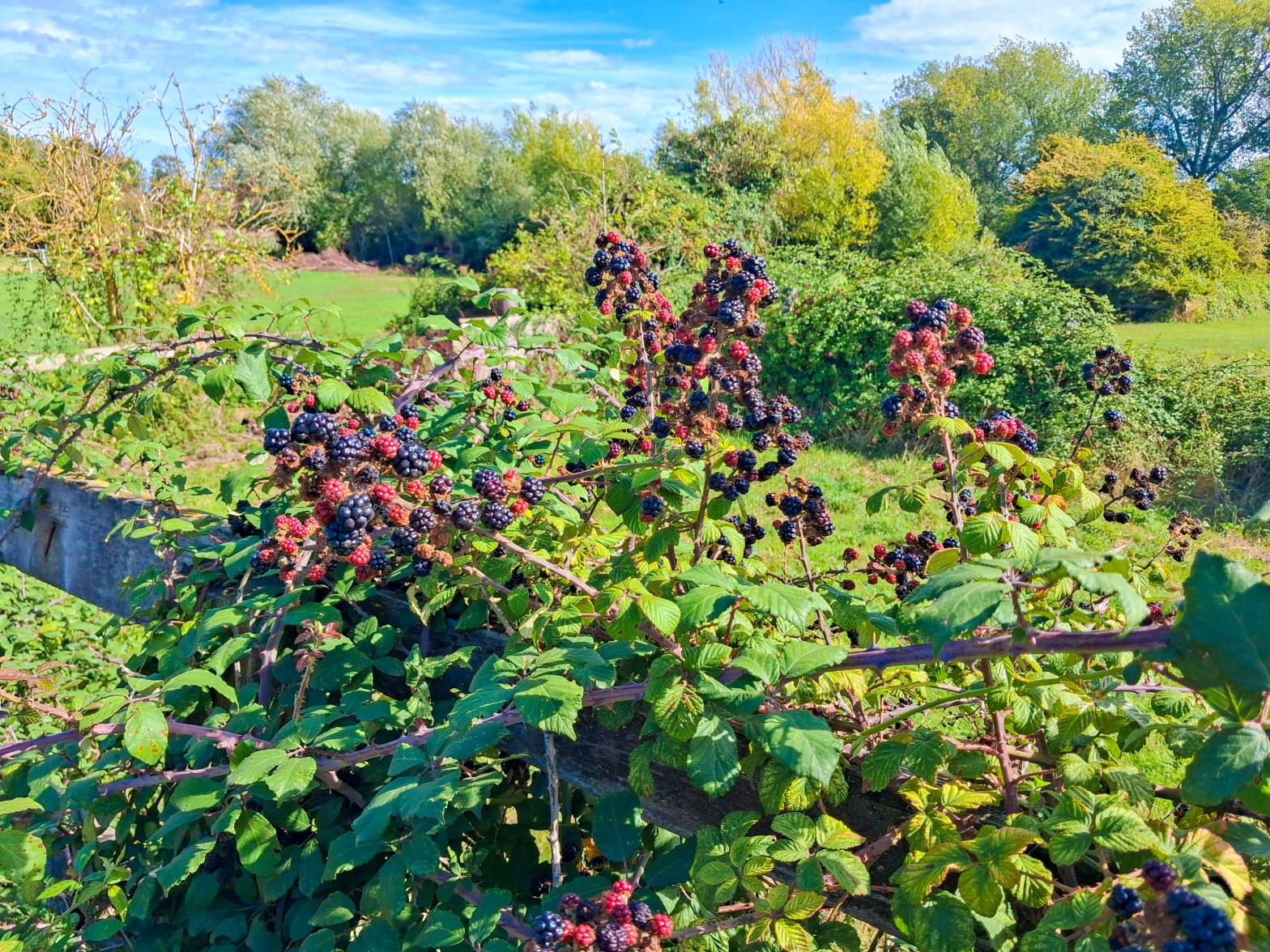
For those who enjoy walking the countryside, this is the time of year to take a plastic bag or container with you on your wanderings. Hedgerow fruits are ripened and ready to be picked – to be eaten there and then or prepared back at home.
Without doubt, blackberries are the most common country takeaway: harvesting the fruits, a pursuit that all the family can enjoy and a childhood activity that leaves an impression. Irish poet Seamus Heaney certainly thought so: “You ate that first one and its flesh was sweet/ Like thickened wine: summer’s blood was in it/ Leaving stains upon the tongue and lust for/Picking.”
And gathering blackberries links us with our forebears. Famously, the stomach of a Neolithic man, well-preserved in the mud of Walton-on-the-Naze on the Essex coast for 4000 years, was found to be full of blackberry seeds when it was dug up in 1911.
As with all popular foods of the hedgerow, folklore surrounds the humble blackberry, one being that blackberries should not be eaten after the Feast of Michaelmas, which takes place on September 29. The legend is that Archangel Michael, for whom the day is named, banished the angel Lucifer from Heaven, and sent him crashing to hell. Lucifer, who at this point became the devil, landed in a thorny blackberry bush, and was so maddened that he spat on the bush and cursed its fruit.
One suspects this tale evolved to warn people not to pick blackberries too late into September, by which time many of the fruits contain mould and bacteria, and can cause stomach aches if digested.

Thorns
While the berries are good for us humans, they are also a vital food source for birds such as thrushes and blackbirds. The berries are pushed out in prominent positions so they can be taken. Through this process, the plant on which they grow, the bramble (Rubus fruticosus), ensures its seeds are dispersed through their droppings.
But there is a contradiction at the heart of the bramble: while blackberries beckon all-comers to enjoy their succulence, the bramble also ensures interlopers remain at a distance. The plant’s long tendrils, which can often be seen whipping around menacingly in the wind, are equipped with rows of dangerous hook-like thorns that snag and rip the skin of those who get too close. These hooks help the stems catch on one another, creating a series of arches that bind together forming a vaulted structure under which small birds and mammals, such as wrens, yellowhammers and field mice, can nest safety but that is impenetrable to larger predators like foxes, crows and kestrels.

Brambles are also plants of the margins. They need sunshine to grow and for their fruits to ripen, so they are often found on the edges of woodlands, footpaths, and railway sidings, away from cover. On a recent walk along the Valley Trail, I saw magnificent clusters of brambles, some climbing 20 feet or so, up and around hawthorn trees.
Rewilding
For gardeners, the bramble’s ability to smother other plants makes it an enemy but, increasingly, conservationists understand its importance to the natural world, especially as the trend towards rewilding has grown. Walk around land that has been given back to nature – such as Suffolk Wildlife Trust’s Black Bourn Valley Nature Reserve near Thurston, and you will see large clusters of brambles dotted across the landscape.

Brambles are often referred to as scrub by conservationists but, to my mind, this uninspiring word downplays their important, pioneering role in secondary forest succession by acting as a natural bridge between open habitats, like abandoned fields or grassland and mature woodlands. Through dormant seeds and their creeping runners, they can quickly colonise disturbed ground and act as a protective shield around young tree seedlings, such as oak, beech, and ash, keeping at bay herbivores like deer and small mammals that would otherwise nibble at them.
In the same spirit, bramble patches form their own microclimate, keeping the sun and wind off saplings and animals alike, preventing the soil from baking and retaining vital moisture. As the protected tree saplings grow taller, they will eventually form a closed canopy, shading out the understory of brambles, and creating woodland.
So, the next time you pass an unassuming bramble patch, take a moment to ponder their value as a biodiversity hotspot and their role in helping woodlands regenerate.

